Blue eyes
The Bluest EyeBlue eyes are both a beauty ideal and a measure of the harm it does in The Bluest Eye. Pecola Breedlove comes to believe that if her eyes were beautiful, she herself would be different—and that her parents might treat her differently too. Her nightly prayer for blue eyes turns an imposed standard into a private hope, while the novel’s fractured repetitions connect that hope to the images, language, and pleasures through which she tries to live with shame.
The ideal and the wish for change
Pecola’s longing begins with the eyes as the organs that hold pictures and know sights. She imagines that if they were different—beautiful—she would also be different. Her wish is not simply to acquire a feature admired by others: it is bound to the prospect of changing how people respond to her. She wonders whether her father and mother might behave differently if she were pretty-eyed, even refraining from doing bad things in front of her. Blue eyes therefore stand for a hoped-for transformation in both appearance and treatment, though the hope places the burden of that transformation on Pecola herself.
Pecola compares her features against the standards around her. She thinks her teeth are good and that her nose is not large and flat like those of some girls considered cute. This comparison makes clear that her desire has taken shape within a hierarchy of beauty: the problem, as she understands it, is not simply that she wants to look attractive, but that she believes another kind of appearance could make her life and her family different. The blue-eyed ideal offers an explanation for suffering by locating its remedy in her own body.
Repetition, prayer, and the primer
The idea takes hold through repetition. Pecola’s imagined blue eyes recur in a quick, insistent chain: pretty eyes become pretty blue eyes, then big blue pretty eyes. The language shifts into the clipped rhythms of a children’s reading exercise, with children running and their blue eyes repeated as part of the same simple pattern. That jarring transition brings the ideal close to the familiar printed world of childhood; it also shows how thoroughly the image has entered Pecola’s imagination.
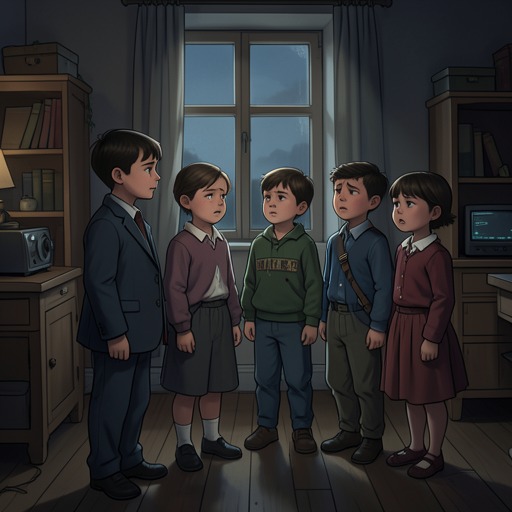
Pecola identifies blue with Mrs. Forrest’s blouse and with the eyes of Alice and Jerry in a storybook. The color does not remain an abstract wish. It is attached to visible examples and reproduced images, each offering a concrete version of the beauty she believes she lacks. Against that repeated promise, the novel presents the distance between what the child’s-book pattern makes seem ordinary and what Pecola hopes to obtain through it.
Each night, without fail, Pecola prays for blue eyes. She has done so fervently for a year. Though she is somewhat discouraged, she has not lost hope. The duration and regularity of the prayer give the wish the form of a ritual: a repeated appeal for a change she cannot bring about herself. Its persistence also reveals how little her desire is a passing fancy. The standard has become central to the way she imagines the possibility of being loved and protected.
Mary Jane and the embodied image
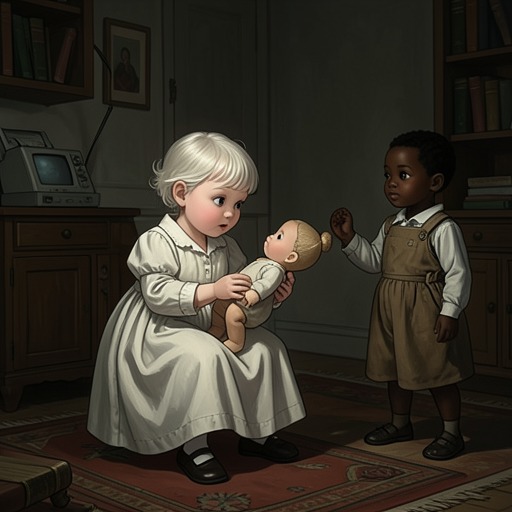
The blue-eyed ideal recurs alongside the Mary Jane candy wrappers, each bearing the picture of a smiling white face with blond hair. When shame rises again, Pecola remembers the wrappers. Their image offers a particular, portable version of the beauty she wants: not only the blue eyes she prays for, but a face framed by blond hair and presented as simply pretty. The candy connects the abstract ideal to an object she can hold and eat.
Pecola eats the candy and finds its sweetness good. In the act, the image becomes more than something to look at: she feels, in effect, that eating the candy is eating the eyes and Mary Jane, and she wants to love Mary Jane and be Mary Jane. The formulation collapses looking, consuming, and becoming into one desire. A picture on a wrapper cannot grant the transformation it represents, yet the candy lets Pecola briefly approach the image through sensation and imaginative identification.
The wrappers also make the ideal repeatable. Their printed face can be encountered again, just as the blue eyes return in the primer-like chant and in Pecola’s nightly prayer. But repetition does not make the promised beauty attainable. Instead, the reproduced image reinforces a standard that Pecola measures herself against, leaving her to seek in an ordinary candy the intimacy and belonging that the image appears to promise.
Significance
Blue eyes expose the cruel logic by which Pecola interprets her circumstances. She imagines that beauty could make others treat her differently, so the wish for a changed appearance becomes a wish for gentleness, recognition, and protection. The imagined reward is relational; the proposed means is self-alteration. In this way, the ideal carries the pressure of a world that teaches Pecola to see her own appearance as the obstacle.
The motif’s forms—prayer, children’s-book repetition, a remembered blouse, and the Mary Jane wrapper—show how the ideal enters ordinary life from several directions. It is something seen, read, repeated, and consumed, not merely a private invention. Pecola’s blue-eyed hope gives those images an intensely personal meaning, while their recurrence reveals the wider aesthetic standard that has shaped that hope. The novel thus makes the wish legible as both an individual longing and a consequence of internalized racism and white beauty standards.